

Buying an LED effect light should be straightforward. The spec sheets make it look simple: wattage, LED count, color options, control modes. Pick the one with the best numbers at the right price.
In practice, it’s more complicated than that. Spec sheet numbers don’t always reflect real-world performance. Features that sound useful may be irrelevant for your specific application. And the cheapest option at purchase often isn’t the cheapest option over two years of operation.
This checklist covers eight dimensions that actually matter when choosing an LED effect light — whether you’re fitting out a single KTV room, building a rental inventory, or sourcing for multiple venues across a region.
1. Indoor or Outdoor?
This is the first question, and it eliminates a significant portion of the market immediately.
Indoor fixtures have no IP rating. They’re not designed to handle moisture, dust ingress, or temperature fluctuations from weather exposure. Using an indoor fixture outdoors — even in a covered outdoor area with humidity — shortens its lifespan significantly and creates safety risks.
What to check: Look for an IP rating on the spec sheet. IP65 means dust-tight and protected against low-pressure water jets — suitable for outdoor events and semi-outdoor venues. No IP rating means indoor only.
The honest answer for most buyers: The majority of KTV rooms, bars, clubs, and event halls are indoor environments. An indoor fixture is fine for these applications and will cost less than an IP-rated equivalent. If any part of your operation involves outdoor events, source IP-rated fixtures for those positions separately.
2. Control Mode: DMX, Music Sync, or Auto?
How the fixture is controlled determines how easy it is to operate every night — not just on setup day.
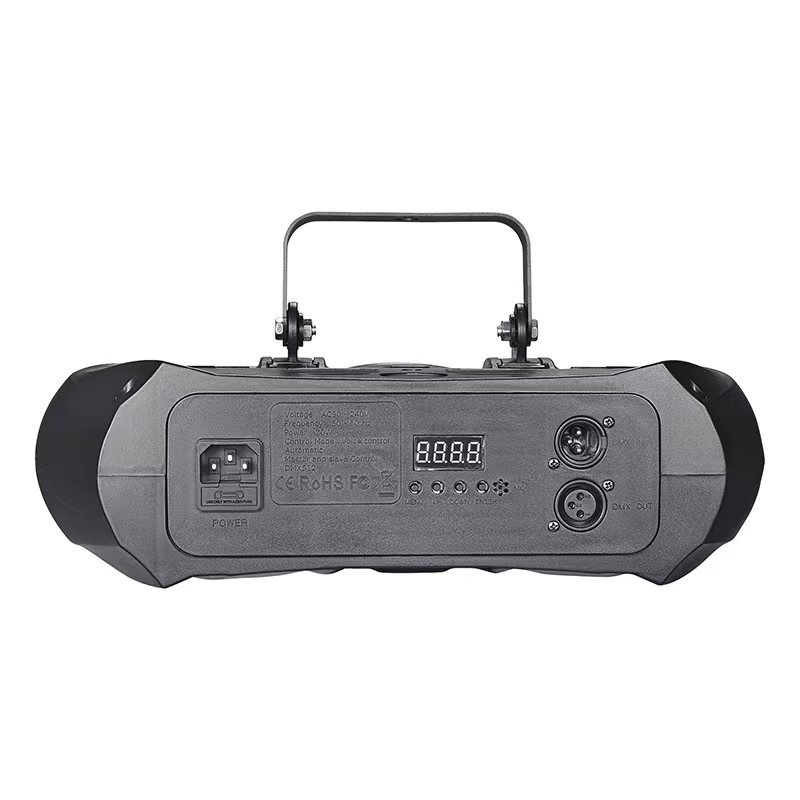
DMX512 gives you precise, programmable control over every fixture in your rig simultaneously. It requires a controller, DMX cabling or wireless transmitter, and someone who knows how to use them. It’s the right choice for larger venues, productions with specific cue requirements, and rental businesses serving professional event clients.
Music sync uses a built-in microphone to drive the fixture’s behavior in response to audio. No controller, no programming, no cables between the desk and the fixture. The right choice for small venues without technical staff, bars and clubs running music every night, and rental operators serving private events.
Auto mode runs pre-programmed sequences on a loop, independent of sound input. Useful for ambient lighting during speeches, dinner service, or any moment where sound-reactive behavior would be distracting.
What to check: Does the fixture support all three modes, or just one? A fixture that supports DMX, music sync, and auto gives you flexibility as your needs change. A music-sync-only fixture locks you out of professional DMX applications permanently.
For a full breakdown of DMX vs music sync, see: DMX512 vs Music Sync: Which Lighting Control Mode Is Right for Your Venue?
3. RGB or RGBW?
The difference between RGB and RGBW comes down to one question: will your venue ever need white or pastel light?
RGB mixes red, green, and blue to produce color. The “white” it produces from full-intensity mixing looks correct in a dark room but wrong in any context where genuine white light is needed — ceremonies, speeches, dinner lighting, photography.
RGBW adds a dedicated white LED. This produces true white independently of the color mixing process, enables clean pastels and skin tones, and generally delivers higher brightness at neutral color settings.
What to check: If your venue hosts events requiring white or pastel light at any point — weddings, corporate events, mixed-use KTV rooms — choose RGBW. If your application is pure saturated color with no white requirement, RGB is adequate.
Also check: The LED ratio within the RGBW configuration. A fixture listed as RGBW with only 2 white LEDs out of 100 total will underperform one with a balanced ratio. Ask for the specific breakdown — for example, R4, G28, B20, W12 — before assuming all RGBW fixtures perform equally.
For a detailed comparison, see: RGBW vs RGB Lighting: What’s the Difference and Which One Should You Buy?
4. LED Count and Configuration
Total LED count is a marketing number. Configuration is what determines output quality.
A fixture with 200 LEDs arranged in a single flat array produces a different result than one with 192 LEDs arranged across dual lenses designed to project patterns across walls and ceilings. The second fixture may deliver a more useful effect despite the lower LED count.
What to check:
- How are the LEDs arranged? Single array, dual lens, multi-head?
- What is the projection angle and coverage area?
- Does the fixture project patterns, wash color, or both simultaneously?
For effect lights specifically, the optical design — how the LEDs are focused and projected — matters more than raw LED count.
5. Power Consumption and Actual Brightness
Wattage tells you how much power a fixture draws. It doesn’t directly tell you how bright it is — LED efficiency varies significantly between manufacturers and component quality levels.
A well-designed 30W fixture using quality LED components will often outperform a poorly designed 50W fixture using cheaper components. Don’t use wattage as a proxy for brightness.
What to check:
- Ask for lumen output data if brightness is critical for your application
- Compare power draw against coverage area and projection distance
- For venues with multiple fixtures running simultaneously, total power draw matters for circuit planning
The practical test: If a supplier can’t explain why their 30W fixture is brighter than a competitor’s 50W fixture, or can’t provide real test data supporting their brightness claims, treat the spec sheet numbers with skepticism.
6. Weight and Mounting
Weight determines where a fixture can be installed and how practical it is to move.
For permanent ceiling installations in small venues, weight matters less — once it’s up, it stays up. For rental inventory that travels to multiple events per week, every kilogram matters. A fixture that one person can carry, set up, and strike without assistance has a real operational advantage over one that requires two people or a lift.
What to check:
- Unit weight and whether the carry handle (if any) is integrated or an accessory
- Mounting options: truss clamp, ceiling bracket, floor stand, table position
- Whether the fixture can be safely mounted at the angles your installation requires
For rental operators in Southeast Asia specifically: equipment that fits in a standard road case or equipment bag, and that one person can load and unload from a vehicle, significantly reduces event day labor costs.
7. Voltage and Plug Compatibility
Universal voltage — AC90–240V, 50–60Hz — covers every market without a converter. This is now standard on most quality LED effect lights, but worth confirming before ordering.
Plug type is a separate issue that universal voltage doesn’t solve. Southeast Asia alone uses Type A, C, F, G, and I plugs across different countries. A fixture that ships with a Type C plug needs an adaptor in Malaysia and Singapore. A Type G plug works in Malaysia and Singapore but nowhere else in the region.
What to check:
- Confirm the voltage range explicitly — don’t assume
- Ask which plug type ships as standard
- Confirm whether your supplier can accommodate your local plug type, or factor adaptor cost into your budget
- For permanent installations, consider having an electrician hardwire the fixture to local wiring, which eliminates the plug issue entirely
For a country-by-country voltage and plug reference for Southeast Asia, see: Stage Lighting for Bars and Clubs in Southeast Asia: What Buyers in the Region Actually Need
8. Supplier Reliability
The fixture itself is only part of what you’re buying. The supplier relationship determines what happens when something goes wrong — which, over a long enough timeline, it will.
What to evaluate:
- Response time: How quickly does the supplier respond to pre-sales questions? Slow pre-sales communication predicts slow after-sales support.
- Warranty terms: What is the warranty period, and what does it cover? What is the process for claiming it across international borders?
- Parts availability: Are replacement components — LED drivers, boards, lenses — available separately, or is a failed fixture a full write-off?
- Order flexibility: Is the supplier willing to start with a small trial order, or do they require large MOQs from new buyers?
- Honesty about limitations: A supplier who tells you what their product can’t do is more trustworthy than one who claims it can do everything.
The practical test: Ask a specific technical question before placing your order. The quality and speed of the answer tells you more about the supplier than any certification or company profile.
For a full framework on evaluating Chinese suppliers, see: 5 Questions to Ask Before Buying LED Effect Lights from a Chinese Factory
The One-Page Summary
| Dimension | Key Question | Red Flag |
|---|---|---|
| Indoor/Outdoor | Does it have an IP rating? | No IP rating for outdoor use |
| Control Mode | Does it support DMX, music sync, and auto? | Single mode only |
| Color System | RGBW or RGB? What’s the LED ratio? | No ratio breakdown available |
| LED Configuration | How are LEDs arranged and projected? | LED count without optical details |
| Power/Brightness | Real lumen data available? | Wattage only, no brightness specs |
| Weight/Mounting | Can one person install it? | No mounting options listed |
| Voltage/Plug | Universal voltage confirmed? Local plug available? | Voltage unspecified |
| Supplier | Responsive, honest, flexible on trial orders? | Slow response, large MOQ only |
No fixture scores perfectly on every dimension. The goal is to understand the tradeoffs you’re making — and to make them deliberately, based on your specific venue, operation, and budget, rather than by default.
Have questions about any of these dimensions for a specific product? Contact us directly →
Related posts:
- RGBW vs RGB Lighting: What’s the Difference and Which One Should You Buy?
- DMX512 vs Music Sync: Which Lighting Control Mode Is Right for Your Venue?
- 5 Questions to Ask Before Buying LED Effect Lights from a Chinese Factory